
What Is Solid Wood?
Solid wood furniture is made entirely from natural timber — each piece cut, shaped, and finished from a single wood species. Common species used in commercial furniture include:
Wood Species | Characteristics | Common Uses |
|---|---|---|
Oak | Hard, durable, prominent grain | Hotel case goods, restaurant tables, reception desks |
Walnut | Rich dark tone, fine grain | Executive office furniture, upscale hotel accents |
Rubberwood | Affordable, eco-friendly (plantation-grown), moderate hardness | Hotel beds, guest room furniture, budget-conscious projects |
Ash | Light color, flexible, shock-resistant | Dining chairs, lounge seating, bar stools |
Birch | Light, smooth, even texture | Painted furniture, children's furniture, cafeteria tables |
Teak | Naturally weather-resistant, high oil content | Outdoor furniture, pool deck seating, resort furniture |
Advantages of Solid Wood
- Durability: Properly maintained solid wood furniture lasts 15–25 years in commercial use
- Refinishing: Can be sanded and refinished multiple times, extending lifespan
- Aesthetic appeal: Natural grain patterns create a premium, warm appearance
- Value perception: Guests and clients associate solid wood with quality
Disadvantages of Solid Wood
- Cost: Typically 2–4x more expensive than MDF or plywood equivalents
- Weight: Heavy, increasing shipping costs
- Moisture sensitivity: Can warp or crack in humid environments without proper treatment
- Inconsistency: Natural variations in grain and color mean no two pieces are identical
Best for: High-traffic, high-visibility pieces where durability and aesthetics matter most — hotel reception desks, restaurant dining tables, executive office desks, and premium guest room case goods.
What Is MDF (Medium Density Fiberboard)?
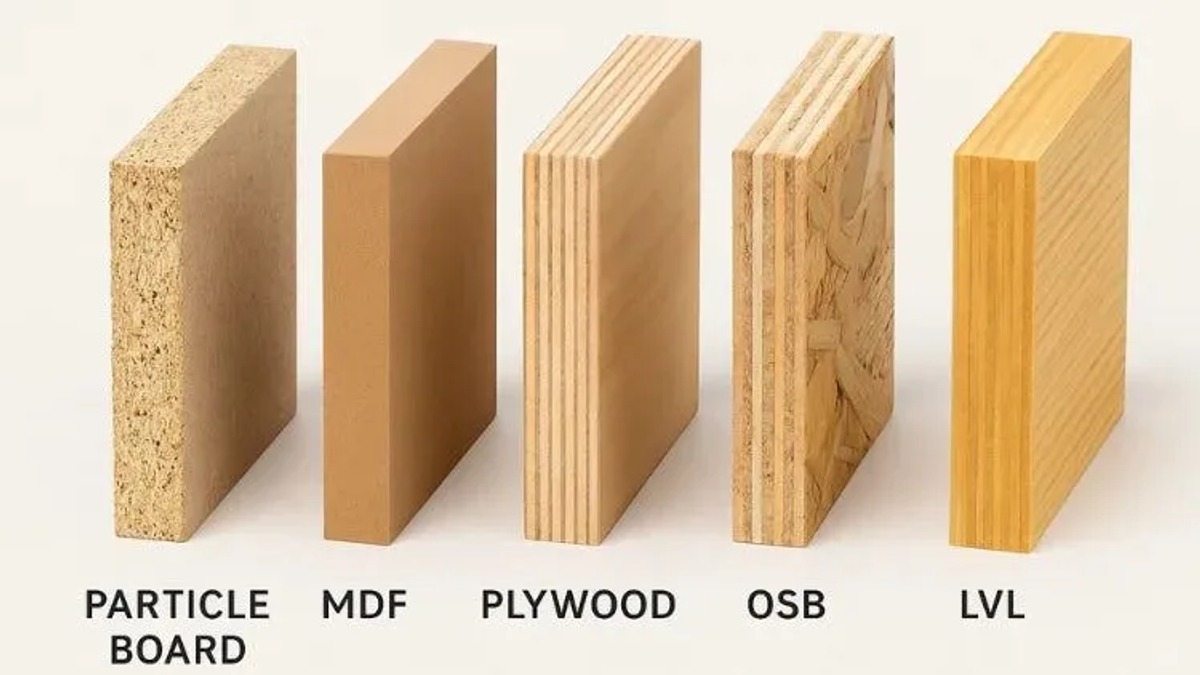
MDF is an engineered wood product made from wood fibers compressed with resin under high pressure and heat. The result is a dense, uniform panel with a smooth surface that is free of knots and grain patterns.
Types of MDF Used in Commercial Furniture
Type | Density | Characteristics | Common Uses |
|---|---|---|---|
Standard MDF | 600–800 kg/m³ | General purpose, smooth surface | Painted furniture, shelving, cabinet doors |
High-density MDF (HDF) | 800–1000 kg/m³ | Stronger, more moisture-resistant | Desk surfaces, commercial shelving, laminate substrates |
Moisture-resistant MDF (MR MDF) | Standard + moisture additive | Resists humidity and moisture | Bathroom vanities, kitchen furniture, outdoor-adjacent pieces |
Fire-retardant MDF | Standard + fire retardant | Meets fire safety standards | Hotel guest room furniture, public area fixtures |
Advantages of MDF
- Cost-effective: Typically 40–60% cheaper than solid wood
- Uniform surface: No knots, grain variations, or natural defects — ideal for painted finishes
- Machinability: Cuts cleanly, takes detail well — excellent for intricate designs and CNC routing
- Dimensional stability: Does not warp or crack like solid wood in response to humidity changes
- Smooth finish: Produces a flawless painted or laminated surface
Disadvantages of MDF
- Not water-resistant (unless specified as MR MDF): Swells and degrades if exposed to moisture
- Cannot be refinished: Once the surface is damaged, it cannot be sanded back
- Heavy: Dense panels are heavy and difficult to repair
- Lower perceived value: Does not carry the same premium impression as natural wood
- Screw holding: Can strip if screws are over-tightened; requires proper fastening techniques
Best for: Painted furniture, cabinet doors, shelving, desk surfaces, and any piece where a uniform painted or laminated finish is desired. Widely used in hotel guest room case goods and office furniture.
What Is Plywood?
Plywood is made from thin layers (plies) of wood veneer glued together with adjacent layers having their grain rotated 90 degrees. This cross-grain construction gives plywood strength in both directions and excellent dimensional stability.
Plywood Grades for Commercial Furniture
Grade | Description | Common Uses |
|---|---|---|
A-grade | Smooth, sanded surface, minimal defects | Visible surfaces, tabletops, cabinet faces |
B-grade | Minor defects, may have small knots | Semi-visible surfaces, drawer sides |
C-grade | Visible defects, knots, patches | Structural internals, backing panels |
Marine plywood | Water-resistant glue, high-grade veneers | Outdoor furniture, bathroom furniture, marine applications |
Birch plywood | Light-colored, fine grain, uniform | High-end commercial furniture, European-standard projects |
Advantages of Plywood
- Strength-to-weight ratio: Stronger than MDF at lower weight — reduces shipping costs
- Moisture resistance: More resistant to warping and moisture than solid wood or MDF (especially marine grade)
- Screw holding: Holds screws and fasteners better than MDF
- Versatility: Available in many thicknesses (3mm–25mm+) and grades for different applications
- Cost: Moderate — typically 20–40% more than MDF but 30–50% less than solid wood
Disadvantages of Plywood
- Edge visibility: Edges show layered plies — requires edge banding or veneer for exposed edges
- Surface quality: Lower grades have visible knots and patches; A-grade needed for exposed surfaces
- Limited for intricate shapes: Does not machine as cleanly as MDF for detailed profiles
- Can delaminate: Poor-quality plywood can separate at the glue layers in humid conditions
Best for: Structural furniture components, desk and table surfaces, shelving, drawer boxes, and any application requiring strength and moisture resistance. A-grade birch plywood is popular in Scandinavian-style commercial furniture.
Head-to-Head Comparison
Factor | Solid Wood | MDF | Plywood |
|---|---|---|---|
Cost | $$$$ | $ | $$ |
Durability | 15–25 years | 5–10 years | 10–15 years |
Moisture resistance | Moderate (species-dependent) | Low (unless MR grade) | Moderate–High (marine grade) |
Weight | Heavy | Heavy | Moderate |
Surface quality | Natural grain (variable) | Smooth, uniform | Variable (grade-dependent) |
Refinishing | Yes, multiple times | No | Limited |
Painting | Requires primer | Excellent | Good (A-grade) |
CNC / intricate shapes | Limited | Excellent | Moderate |
Screw holding | Good | Fair | Good |
Fire retardant options | Limited | Yes (FR MDF) | Limited |
Perceived value | Premium | Standard | Standard–Premium |
Best for | High-visibility, high-traffic | Painted, uniform finish | Structural, moisture-prone |
How to Choose the Right Material for Your Project
By Furniture Type
Furniture Type | Recommended Material | Why |
|---|---|---|
Hotel reception desk | Solid wood or A-grade plywood | High visibility, needs durability and premium appearance |
Guest room bed frame | Solid wood (rubberwood) or plywood | Structural strength needed; solid wood for upscale, plywood for mid-scale |
Guest room desk & nightstand | MDF (painted) or plywood | Uniform painted finish; cost-effective for 100+ rooms |
Guest room wardrobe | Plywood or MDF | Internal structure uses plywood; painted MDF for door panels |
Restaurant dining table | Solid wood (oak, ash) or plywood top | Needs durability and moisture resistance |
Restaurant chairs | Solid wood (ash, birch) frame | Structural strength for daily commercial use |
Bar stools | Solid wood frame, plywood seat | Frame needs strength; seat can be plywood with veneer |
Office desk | MDF or plywood with laminate | Cost-effective, uniform surface, supports heavy use |
Office chair | Plywood (seat/back shell) | Strong, lightweight, holds shape well |
Solid wood (teak) or marine plywood | Must withstand moisture and weather exposure | |
Retail display shelving | Plywood or MDF | Structural strength; painted MDF for a clean look |
Built-in cabinetry | Plywood structure, MDF doors | Plywood for strength; MDF for smooth painted doors |
By Project Tier
Project Tier | Primary Material | Secondary Material | Budget Impact |
|---|---|---|---|
Luxury / 5-star | Solid wood | A-grade plywood | High material cost, premium result |
Upscale / 4-star | Solid wood (key pieces) + plywood | MDF (painted pieces) | Balanced cost and quality |
Mid-scale / 3-star | Plywood | MDF | Cost-effective, consistent quality |
Budget / 2-star | MDF | Plywood (structural) | Lowest material cost |
Common Mistakes When Specifying Materials
Mistake | Why It Hurts | How to Avoid |
|---|---|---|
Using standard MDF in humid areas | Swells, warps, and degrades | Specify MR MDF or plywood for bathrooms, kitchens, and tropical climates |
Using low-grade plywood for visible surfaces | Knots and patches show through finish | Use A-grade or B-grade for exposed surfaces; C-grade for internals only |
Expecting identical grain in solid wood | Natural variations cause perceived "inconsistency" | Educate stakeholders that variation is a feature of natural wood, not a defect |
Specifying solid wood for everything | Unnecessary cost for hidden components | Use solid wood for visible, high-touch surfaces; plywood or MDF for internals |
Ignoring fire-retardant requirements | Fails local fire safety codes | Specify FR MDF or fire-treated wood for hospitality and public spaces |
Not sealing plywood edges | Moisture ingress causes delamination | Require edge banding or veneer on all exposed plywood edges |
What to Tell Your Supplier
When requesting quotes, always specify:
- Material type and grade (e.g., "A-grade birch plywood" not just "plywood")
- Thickness in millimeters (e.g., "18mm plywood" not "3/4 inch")
- Surface treatment (e.g., "natural oak veneer," "white lacquer paint," "walnut stain")
- Moisture resistance requirements (MR MDF, marine plywood, or sealed edges)
- Fire retardancy requirements (FR MDF, fire-treated wood, fire certificate reference)
- Compliance standards (FSC, E0/ENF formaldehyde emission, BIFMA)
Pro tip: Always request material samples before placing bulk orders. A small sample cost upfront saves thousands in rework later. A reliable China sourcing agent can coordinate sample requests across multiple suppliers and verify material specifications before you commit.
Frequently Asked Questions
Is MDF furniture bad quality?
Not necessarily. MDF is an excellent material for painted furniture, cabinet doors, and shelving where a smooth, uniform finish is desired. The key is using the right grade for the application — standard MDF for dry areas, moisture-resistant MDF for humid areas, and fire-retardant MDF for hospitality. MDF used correctly in commercial furniture performs well for 5–10 years.
Is solid wood always better than plywood?
No. Solid wood excels in aesthetics and refinishing, but plywood is stronger for its weight, more dimensionally stable, and more moisture-resistant. For many commercial applications — desks, shelving, drawer boxes — plywood is actually the better engineering choice. Solid wood is best reserved for high-visibility, high-value pieces where natural grain adds to the design.
What is the most durable material for hotel furniture?
For hotel furniture, solid wood (especially oak or rubberwood) offers the longest lifespan at 15–25 years, followed by A-grade plywood at 10–15 years. The most durable choice depends on the specific piece: solid wood for guest room beds and reception desks, plywood for structural components, and MDF for painted cabinet doors and shelving.
Can I use MDF for outdoor furniture?
No. Standard MDF absorbs moisture and will swell and degrade outdoors. For outdoor furniture, use solid teak, marine-grade plywood, or PE rattan over an aluminum frame. If you need a painted outdoor finish, use moisture-resistant MDF with thorough sealing — but solid wood or marine plywood remains the safer long-term choice.
How can I tell if a supplier is using the material I specified?
Three methods: (1) Request sealed samples with material certification documents before production. (2) Conduct a pre-production inspection to verify raw materials at the factory. (3) Use a third-party QC service to check materials during production. A quality control partner experienced in furniture manufacturing can verify material specifications on your behalf.
What does E0 or ENF mean for MDF and plywood?
These are formaldehyde emission standards. E0 means the board emits less than 0.05 mg/L of formaldehyde. ENF (Emission Non-detectable Formaldehyde) is the strictest standard, with emissions below 0.025 mg/L. For hospitality and commercial projects, especially in markets with strict indoor air quality regulations (EU, US, Australia), specifying E0 or ENF grade materials is recommended.
Need Help Specifying Materials for Your Project?
Choosing between solid wood, MDF, and plywood is just one of many decisions in your FF&E procurement process. The right choice depends on your project type, budget, design requirements, and target market standards.
At sourcingchn, we help international buyers navigate material selection, factory matching, and quality control for hospitality and commercial furniture projects. We work with factories across Foshan, Dongguan, and Zhejiang that specialize in all three materials — and we verify that the materials specified in your order are the materials delivered.